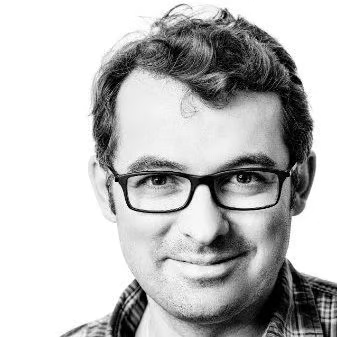
hi I'm James McGuire editor of data mation and today we'll be talking with six Enterprise it vendors to see what's new and emerging in Tech today we'll give each vendor about five minutes or so to talk about their product why it might make a difference to your company and uh rather than introduce everyone here at the beginning let's just go ahead and start from the top and we'll go right through it again just a few minutes for each person uh starting us off is Rajiv dut CEO of dimensional mechanics hello to you Rajiv hello hi yes fantastic and again as someone noted I love your background there are those all the uh the computations that go into the AI formula yes these are H it's basically it's a back propagation algorithm so it work it looks like it's pretty complicated so tell me about your product what what is the product today for you well one of the things that uh so we're addressing uh one of the major uh growth areas uh in the in the Enterprise World which is uh artificial intelligence the um we we know that there are a lot of uh obstacles to growth we know that for example the cost of AI is in many cases prohibitive it's basically the uh algorithms as you can see are pretty complex a lot of times you require specialist skills the amount of data you need to train AI platforms is pretty uh pretty intensive so what we're doing is we've created an operating system for AI and what that means is that it's basically we're automating a large part of the process of building up AI Solutions what this means is that we have um we're taking care of a lot of the messy details that typically go into uh creating this uh we have um behind it of course we also have a lot of uh capability to scale out uh so that enterprises don't have to worry about things like that um we're Target the platform is called neopulse it is a cloud-based platform uh we are um uh it is currently hosted on a WS uh to start um we have uh primarily targeted ourselves initially because that we startup we need to place to begin uh at the media industry the media industry is a particularly a challenging area uh because of the fact that there's a ton of data and there are a lot of people we there's just no way to analyze and process that information and we've gotten a lot of interest from media companies we were at the um IBC so International broadcasters conference and we got a tremendous level of interest uh because of the fact that there's a lot of content people don't how to organize it but Rich go ahead and give me a a real world example of the product like how would someone use it in a day-to-day basis so the the way that you'd end up using our platform so we have two ways one is we have a lot of outof the-box uh AI models that we've already pre-trained these are things like uh for a media company it would be being able to um for example detect adult content uh being able to apply metatags to um videos like for example saying that Jennifer Lawrence just appeared in this part of The Hunger Games uh we have uh also the capability to um analyze and optimize headlines so we're we're doing this for a big uh broadcaster um to actually determine what is the ideal set of headlines to attract clicks um so there's a range of things that we are actually working on um that's the first part the second part that we're working on is um being able to train your own AI quickly with a minimum set of data uh what this means is that if you're a company or you're trying to build a machine learning cap solution uh say for example you're in the medical space you want to train your an AI to detect tumors uh you can use our platform um and with a smaller data set uh be able to uh build up a AI model or machine learning model that's capable of detecting tumors does that answer your question uh it does it's fantastic and I I should move on but it's really neat I'd like to check it out some more I think obviously artificial intelligence is a is a a amazingly rapidly growing area it might be like now is is ai's Big chapter it feels like oh absolutely and and and we're striving to become like part of that uh backbone fantastic okay uh thanks for for uh chatting with us and let's move on to uh tun ther CEO of uh Doos iio hello to you teron hi James how are you thank you for the opportunity good good and and you're talking about something called recover X it's a cloud-based data protection uh solution if correct in thinking that that is correct that is correct so what what makes uh recover X you know important and I guess the other question would be you know data protection cloud-based data protection is certainly a crowded field so what what sets you folks apart excellent thank you um James again thanks for the opportunity and good to be with the rest of the peers here um you know absolutely Rajiv talked about it pretty exciting in a in a space like Ai and machine learning we're on a completely uh other end of the pendulum with with backup and recovery and you know really if you look at that space that space has not been innovated for the last 25 years um recover x uh you know what how we Define it for our customers for our partners is really cloud skill data protection software purpose built very purpose built for uh you know these next Generation applications and non- relational databases right so if I can peel that on in a little bit uh what we mean by that is you know if you really look at the fast changing nature of Enterprises to right they want to adopt analytics they want to adopt iot they want to adopt SAS applications these sort of more two applications as got calls them reside on sort of non-relational massive skill databases like a Cassandra like an Amazon Dynamo DB like an Apache hbase so if there has been a sort of a fundamental shift in both application tier and a database tier the data management the data protection the data protection and Recovery space is still Arch we're still talking the world of tape media we're still talking the world of on premises tape is not dead surprisingly enough yep that is correct right now we're talking cloud as the new tape so so you know essentially in short we Cloud skill data protection and recovery software purpose buil for your non-relational databases and what about um theya scaling out is it is it a big part of what you do or how does that work no that's that's again that's the key part of uh you know one of the four pillars of the product itself is the product itself is distributed software only platform right in the world of cloud and world of Big Data you know we don't want to sort of mire people around appliances we want to give them the freedom of Hardware choices build a software only platform that could be either on premises or hybrid cloud or CL Cloud native it is horizontally is a horizontal three node scaleout platform so you know it's it's scale out to begin with and you know will sort of keep growing datas itself from three node to five node to seven node and is it uh geared more for the SNB Market or for the larger Enterprise market so you know our first early adopters again good question you know where we're getting a lot of success is is uh is actually by Enterprise customers who are really sort of again adopting these either e-commerce applications on cloud infrastructure you know you look at where mongodb or Cassandra or Apache HB has been successful and these are public case studies all of ebay.com runs on mongodb your ADP your intute your Carfax these are all public case studies all of these big large Enterprise accounts who are onboarding you know non-relational databases which were non-existent 8 years ago right and so so very much Enterprise Enterprises uhuh and I I was reading about you and I came across the phrase uh semantic duplication I know that obviously DD is a huge part of of uh you know Enterprise storage but talk me about semantic D duplication how does that play a role in recover acts thank you thank you for for for the curious curious eye there Jes I'm I'm always curious I know so little I've got to be curious uh so so you know if you really look at again D duplication you're absolutely spot on you know data domain which is where I come from really is considered the Godfather for uh sort of coming up with with with the duplication inventing that technology for the world um and then you had Nimble and all the other players like Pure Storage who have invented or sort of innovated in that space semantic duplication invented it for your non-relational Cloud databases and what we mean by semantic D duplication it's not a fixed length or a variable length D duplication about data stores that are keys and values right to give an example James lives in Boston Boston is where James lives it semantically means the same thing Jame lives in Boston right but it can be represented either James lives in Boston or Boston is where James lives semantically it could be presented in a different form values how do you go D duplicate a data set such as the one that we just described and that is where half of our IP is excellent ter thanks a lot for of course thank you thank mute your microphone because we're getting a lot of feedback but let's move on to uh Irwin manard president and Chief Operating Officer of scal uh Irwin how are you doing today hi how are you and thanks opportunity good and you are you are talking about the ring what what for goodness sakes what is the ring tell us all about that so the ring is software software only uh product that helps you building paby scale storage systems on commodity Hardware so basically we are a a world leader in object and cloud storage and we give you as a service provider or as an Enterprise a similar secret source to the one that Amazon Facebook or Google have developed for themselves so a software running on commodity Hardware to build pyte scale capacity storage that's really I don't want to interrupt you too much but the idea of like software ritten a commodity Hardware is very much much the last few years that idea has took off like a storm has it now it has and I think I think fundamentally U this storage industry has been you know very uh uh dominated by the appliance form factor for a long time and the reasons why these was happening are no more valid I mean if you want to extract performance from the same disc drive everybody's using you do not need anymore to redevelop lowlevel operating systems you can just uh use commodity Hardware powerful servers and run in a fully distributed fashion like the cloud players have showed us now making that available to an Enterprise allowing them to touch the same economics as the Giants that's that's really what's uh what's helpful because everybody's growing Digital Services and needs to store more and more you know the ring and I the one thing I found really interesting is that it enables aord to your website 100% data availability and zero downtime and I know that so many vendors will talk about multiple n you know 99.999 you're actually using the figure 100% which is kind of shocking how do you get to 100% well so first of all Hardware fails and fails all the time so the magic is in the software to be able to survive Hardware failures this product has been designed from day one as being able to be upgraded without downtime as being able to suffer a dis a server a rack a data center failure and resist so we just help our customers dimensioning accordingly and yes in our premium support contract we take slas and we take Financial penalties against it because we've built over the years the confidence about about the product the first customer uh started using the product in 2010 a service provider out of Belgium and they've grown the system by a factor 20 with four different generations of Hardware they've mixed and matched underneath and never took a second of downtime and never lost or corrupted data So based on that experience we decided to you know build the promise in our own support contract but I think the the high availability only one side of it the other important aspect is to talk to both Legacy and new applications so at hardware and Object Store if your website you control your stack you can develop straight to an object interface you'd probably choose S3 which is the market Standard nowadays but what about your legacy application if you're a car manufacturer who's designing cars and doing simulation work relying on Legacy application or what about your media company was used to move content and distribute content with a legacy stack speaking five system well we're giving you a scale out fire system that is above the object store you get the same economics it's all the same product but you do not need to change your application and so we can hold your hand as you move from the classic Nas you know Delux in California in the Medan entertainment industry has happily replaced emci Salon Systems with scal software on D Hardware to to distribute their content and that's very important if we want to help people taking advantage of those Cloud Technologies uh another example is S3 um which is now the DEA facto object storage standard so we just refreshed our S3 um connector as we call it and so basically this is offering you in a private Cloud on premise fashion the exact same storage as you have on Amazon to the point that we're the only ones allowing you to use the same policies identity and access management as Amazon calls it as well as your active directory by the way than if you were on on on the public cloud and so you you can start thinking of developing your application in a multicloud environment some data will end end end up on Prem and we think we we're a wonderful back end for that some will end up in the public cloud and we don't want you to have to modify the app we effectively released an open source version of that S3 uh storage solution so that developers Community can start uh building S3 like storage system on their own machine without having to use their credit card or deciding am I going to end up putting the data in a private cloud or in the public cloud or a mix of both Erin thanks a lot uh we'll keep us posted I should move along to Eric Carter vice president of hedvig Eric are you with us today I am here and hopefully you can see and hear me I can I can definitely see and hear you quite clearly um now you're talking about head viig distributed storage platform which do software defin storage correct correct and so similar to some of the things that we've already heard uh it we're really talking about this sort of new world of being able to take a software layer separate from a hardware layer so typically now commodity Hardware x86 servers full of Flash and disort of being able to build a scaleout storage system modern system much and again some of the things that we've already heard one of our claims to fame and I've already heard it invoked today on this uh on this particular broadcast is that our founder is was the guy who created Cassandra so he's been quite an impressive feather I mean feather in the cap so we love to say that every time simply because building some of these Technologies these guys did you know he was at Facebook when he created Cassandra before that was at Amazon uh and and was co-creator of Dynamo they not only generate these Technologies because they felt a need to do so um for various reasons which we can we can get into but they operated them so there's this idea that I need to build something that not only you know scales and and sort of helps drive out you know downtime and things which is why I was brought in but I want it to to to sort of work when I'm home on the weekend and sleeping at night I don't want to have to get up and go troubleshoot things right so you try and build in Simplicity and sort of the again some of the things we've heard today the idea that these systems are sort of selfhealing and take care of themselves in the dark of night when something fails it's okay that something fails we can survive that and that's a lot of what gets baked into software Define distributed systems thinking it was interesting I was reading about you guys and it I see you offer both hypers scale and Hyper converged options what do you mean by that yeah it it is a an architectural choice I would say if we we look at what's happened over the past several years hyperon converged has been a sort of packaging of some of the same things that we're talking about here that run co-resident with a hypervisor that make it a sort of a building block so I'm using some of the web scale Technologies and techniques but I'm also kind of putting it all together in something that I can sort of roll in and plug in it it is it has been a helper to organizations seeing how they can start to adopt things like software def find infrastructures now we when we say we do both you can take our software and sort of deploy it in that manner but what we see is sort of more of a pendulum swing toward hyperscale which is really a word that tries to describe disaggregation meaning I want to be able to scale my storage tier separate from my compute tier separate from my software defi Network tier why you would want to do that is is sort of a little bit into what our vision is at head we're we announced last week this vision of a universal data plane so think about being able to have a layera wherever I want it to be wherever I need it to be so not just my private data center Amazon Google Azure it could be all Cloud meaning all public or it could be a mixed so having some way to determine locality of data when I need it and have that happen automatically and availability of data so I can start to move applications around as it makes sense and have my storage sort of as a utility that's available and there for me and that was this vision of a of a universal data plane that we're starting to talk about now here at headbig what about the idea itself of a software defined storage and I think about you know the software defined data center which seems like it's more of a gleam on the horizon than really a reality is it is is I mean six months ago I thought to myself well software defined is still in its infancy is it it's still accurate here in late 2016 that software defined is still still very much a toddler yeah I I think that's a that's part of the description we'll we'll give it but it depends on I mean yes it's early days it's definitely early days for software to find storage but again as some of my colleagues here on on on the broadcast have said today we're starting to see that commodity Hardware layer the intelligence and everything is in software we've already seen it VMware look at that that's a software defined platform we're now seeing Docker and containers and part of what we're trying to do at at head is they kind of have a philosophy that says you know any workload any cloud and any tier so that you can have a single storage solution that helps you service where whatever the workloads you may have because everyone is sort of marching toward the sort of digital strategies I want to have apps that sort of get me ahead of my competition I need everything to be fast and how do you do that you can't do that with traditional storage and traditional Stacks you can start to do that when you adopt some of the techniques again that that folks like ainos have helped Pioneer so it's a it's really interesting times Early Times which is goodness there are no shortage of us sort of in this space and we're all things out there's lots of white space but it seems like every Enterprise we encounter have some sort of commodity strategy going and uh we're there to help have those conversations I I'm quite sure a growing area so thank you very much great thanks for talking with us um next up is yaran haviv a founder and chief technical officer of agazio yaran are you there I see you've got your microphone muted and now I see oh there you are okay now I see two of you but your second one your old microphone is muted so you need to unmute your microphone no we we we we see you but we we see only silence and unless we can lip read that probably wouldn't be too much Yar do you know yeah do you hear me loud and clear okay now we can hear you great so you're talking about the iguazio data Cloud correct yes okay so iguazio we're a theme of sort of experts coming from networking storage my co-founder for example founded extreme IO which was bought by EMC we also have guys from XIV and other firms I myself will serve a VP for all the data center activities in a company called melanox if you heard of it right and basically basically what we're building is uh what we call Enterprise data clouds uh this is a very unique and Innovative platform in Ser think about it as a bare metal database uh it's called multi model database because it can store any form of data objects files tables streams all that and it's uh the fastest one in the industry it can generate for every server that R it runs uh 2.5 million operations per second you know 12 gigabytes per second less than 100 microsc across variety of access patterns so if you look at the fastest file system today that exists it does about 200,000 iops you know from some the old flash vendors uh if you go to like isolon or those it's way less we do 2 million file iops per second on a single server and same thing could act as a database you can do two million database operations per second on the same thing and this thing is managed as a platform as a service uh with very high decoupling between the API layer and the engine so we basically provide all the Amazon apis we provide S3 Kinesis Dynamo a bunch of others we have integration native integration with things like Hadoop and Spark so this platform allow organizations to basically build sort of unify their data around the data Lake it also has a notion of a layer 7even firewall within the data layer so every data that goes in and out basically gets fully classified and you could determine even at the level of column or field or content uh what is going to happen with the data what about the idea of um The Internet of Things I was reading about you and it seems like there's some way that you actually facilitate iot how how does that work out yes I actually just had a session on realtime iot here at Str is uh the biggest challenge with iot there's huge amount of ingestion of data okay lots of small data you know all the traditional storage including some of the you know all the software defin and all that they're basically block and file every time you need to open a file that's a very heavy operation for our file system that's why in those cases people use like object or more of no SQL Solutions and again you need to ingest millions of operations per second we're the only ones today in the industry that can take a server and in just so many millions of operations per second but also have full deep classification of the data so guaranteeing security uh you know some of those iot devices will be in pretty sensitive locations including power plants and other things you don't want to have someone hack them so the combination of being able to uh stream those this data from all the Cent answers understand the context secure it and on the other side being able to analyze it by tools like spark and produce offloads we have very unique offloads for things like spark because we are sort of a database by heart and then for when you run spark on us all the query Primitives are being offloaded to us and we can accelerate Spark by about 100x so you know use a lot less servers to do the job and on the same time basically create more real insights from the data you know and I you may have covered this but I wasn't totally sure what your relationship was with with uh AWS as you are you in cooperation with them or competition with them uh I serve competition because uh we are the only ones today that serve in the on Prem space that deliver a real alternative of a data platform as a service uh think about uh you know Amazon you don't think about infrastructure you don't think about discs or lands or or those kind of things you have portals which are selfservice and a guy could just go and create his own data related stuff and that's how our system works it's better than Amazon in the sense that all the different apis in Amazon that we support are individual packages that means that if you want to move data from one to the other you need to copy uh what we did which is very tricky and we have patents on that is you can actually write in one API in just something as a stream for from for example from iot devices or just uh you know message cues and you could write the same data from a different model like a table or a file or an object and you know where some people say you know if you do different models you're probably not as good on one versus the other and what we've demonstrated that we're faster on each one of them at least by 10x we faster than the file fastest file system by about 10x we're faster about 100x than many of the um you know Amazon Services even something like S3 which you know my colleagues uh here talked about traditionally uh it's like few thousands of operations per second and on our platform a single client can push about 800,000 S3 operations per second uh which is uh faster than the fastest file system that exists so we changed some paradigms here in terms of performance and that's due to a complete re architecture that we did we don't have block storage underneath we don't have file system it's sort of a think about a bare metal uh database that can actually store files within it so if you want you can actually run a SQL statement saying you know give me all the files from Joe from thanks sounds good I do need to move on but I very much appreciate it post uh thank you and you may want to mute your microphone now because I know sometimes might be feedback but no problem sorry last but certainly not least uh Joe naggie VP of sales for Zetta Joe how are you doing today I'm well thanks how are you today good and uh you were talking about something called The Zeta disaster recovery system if I'm correct in that that's correct yeah so about a few months ago we added to the uh to our data protection solution a Disaster Recovery Solution so Zetta has been around for about nine years and uh like the rest of the gentlemen on this on this group our Founders have some pretty stored backgrounds one uh created the web cookie they all met when they were at Netscape and they be all our patents around um speeding up uh transmission of data from a uh from from a normal Network up to the cloud thereby redu Elimina need for an appliance in between in the process so we've been all Cloud for uh since the start of our organization and made it uh an added disast recovery to that at this point so I ask you a similar question I know that cloud-based backup and Recovery is is a is a crowded field a Big Field what what what sets you apart in that in field well pretty one one of the funny things that's sets us apart is really kind of our speed and we've had we've uh we work with um both the direct customers as well as uh managed service providers and uh constantly hearing from Mana service providers when they um when they talk when they test our solutions that uh they they don't bother with the throttles because they haven't had a need to and we're the only ones that so far that have been been able to bring down their systems and then they quickly you know either recognize the fact that they need throttles or they call our 247 365 engineering support and say hey what's going on throttle it back and it'll be just fine I guess that's the thing I think about one of the headaches of of cloud based backup is is moving things over the internet are you you have some some fancy way of doing that well yeah that's where our patents are all around um speeding up Wan conversion as well as instead of doing D duplication we simply uh move the differentials around and so that's where that's where all the patents round up and so we've been able to um kind of eliminate the traditional bottleneck that You' find uh in moving things around now you know you have a you have a client if you're an MSP or if you're a direct customer yourself and you're on two cans and string we run into the same issues that everybody will but for the most part um we've eliminated that and some of our clients have found that believe it or not that backing up to the cloud can be faster than backing up to a landbased system oh okay and what about the MSE MSP as the manag service providers how are you working with them oh well generally what we're doing is they found it very valuable to uh as well as direct customers have found it very valuable when they have um more geographically dispersed data sets so we're a really affordable option as for as very easy to set up and the fact that there is no Appliance required allows us to put the system pretty much anywhere it's all software based and so as an MSP that's great because if you're using a if you're using a solution and you're trying to get into recurring rather than recurring um income rather than a type typical break fix you really don't want to have you know which if you've got Hardware out in the field which one's going to break the one farthest away what time is it going to break at 2 am and so if you're charging on a monthly basis you end up uh you end up blowing up that month's um profits if you end up having to go out and fix something uh so you've got you got a minute or so left Joe what do you think really really matters about Zeta in terms of making it different well I think really what really matters about us is the ability to simp we have a for instance we have a h Hotel chain that just signed up with us and their ability to store their data in the cloud provide a Ser server image back and then also have a disaster recovery uh solution for things like the reservation system or the key system that basically turn a hotel you know turn a turn a turn a building full of rooms into an actual Hotel the ability to protect their entire business whether it's data or whether it's applications that they're running and how important those applications are is really something that we offer folks fantastic uh and I I I thank the six of you actually so much good stuff uh just really that is what's happening in Enterprise it today I will uh edit this lightly and I'll send you all the link we can we can tweet about it but I very much appreciate the six of you sharing your products and I'll talk to you soon thanks thank you thank you by bye bye bye thanks
This transcript was generated automatically from the
video's captions and may contain errors.