Wearable device vendors shipped 22.5 million units in the second quarter (Q2) of 2016, a 26.1-percent year-over-year jump, according to IDC’s latest analysis of the market. Buyers are flocking to basic wearables like the fitness trackers popularized by the current market leader, Fitbit. IDC defines basic wearables as a category of devices that don’t support […]
Datamation content and product recommendations are
editorially independent. We may make money when you click on links
to our partners.
Learn More
Wearable device vendors shipped 22.5 million units in the second quarter (Q2) of 2016, a 26.1-percent year-over-year jump, according to IDC’s latest analysis of the market.
Buyers are flocking to basic wearables like the fitness trackers popularized by the current market leader, Fitbit. IDC defines basic wearables as a category of devices that don’t support third-party apps. Last quarter, shipments surged 48.8 percent year-over-year.
“Basic wearables, which include most fitness trackers, have benefited from a combination of factors: a clear value proposition for end-users, an abundant selection of devices from multiple vendors, and affordable price points,” said IDC research manager Ramon Llamas, in a statement. “Consequently, basic wearables accounted for 82.8 percent of all wearable devices shipped during the quarter, and more vendors continue to enter this space.”
The success of Fitbit’s line of Charge fitness trackers and other health wearables presages a potential glut of me-too devices, warned Llamas. “The danger, however, is that most devices end up being copycats of others, making it increasingly difficult to differentiate themselves in a crowded market.”
Meanwhile, smart wearables, which can support third-party apps, didn’t fare as well. Shipments dropped 27.2 percent in Q2 compared to the same quarter a year ago. Despite clear interest from buyers, they are “struggling to find their place in the market,” observed Llamas.
“The good news is that smart wearables are still in their initial stages and vendors are slowly making strides to improve them. But this also means that it will be a slow transition from basic wearables to smart wearables,” Llamas added.
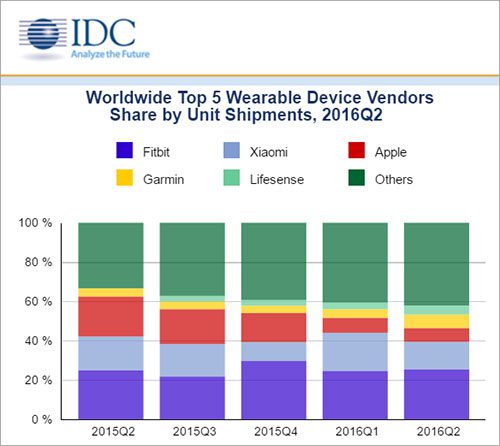
Fitbit emerged the market leader in Q2 with shipments of 5.7 million units and a 25.4-percen share of the market. China’s Xiaomi, maker of the popular Mi Bands, shipped 3.1 million devices and claimed 14 percent of the market.
Apple shipped 1.6 million Watches – the company’s one and only wearable – and took third place with 7 percent of the market. “Apple was the only vendor among the market leaders to post a year-over-year decrease in shipment volumes, primarily because it did not launch a new model on the anniversary of its first generation Watch,” noted IDC. The Cupertino, Calif. device maker is expected to announce a follow-up to its smartphone (along with a new iPhone) at a Sept. 7 media briefing.
Garmin and Lifesense round out the top five with shipments of 1.6 million and 1 million, respectively.
Pedro Hernandez is a contributing editor at Datamation. Follow him on Twitter @ecoINSITE.
-
Ethics and Artificial Intelligence: Driving Greater Equality
FEATURE | By James Maguire,
December 16, 2020
-
AI vs. Machine Learning vs. Deep Learning
FEATURE | By Cynthia Harvey,
December 11, 2020
-
Huawei’s AI Update: Things Are Moving Faster Than We Think
FEATURE | By Rob Enderle,
December 04, 2020
-
Keeping Machine Learning Algorithms Honest in the ‘Ethics-First’ Era
ARTIFICIAL INTELLIGENCE | By Guest Author,
November 18, 2020
-
Key Trends in Chatbots and RPA
FEATURE | By Guest Author,
November 10, 2020
-
Top 10 AIOps Companies
FEATURE | By Samuel Greengard,
November 05, 2020
-
What is Text Analysis?
ARTIFICIAL INTELLIGENCE | By Guest Author,
November 02, 2020
-
How Intel’s Work With Autonomous Cars Could Redefine General Purpose AI
ARTIFICIAL INTELLIGENCE | By Rob Enderle,
October 29, 2020
-
Dell Technologies World: Weaving Together Human And Machine Interaction For AI And Robotics
ARTIFICIAL INTELLIGENCE | By Rob Enderle,
October 23, 2020
-
The Super Moderator, or How IBM Project Debater Could Save Social Media
FEATURE | By Rob Enderle,
October 16, 2020
-
Top 10 Chatbot Platforms
FEATURE | By Cynthia Harvey,
October 07, 2020
-
Finding a Career Path in AI
ARTIFICIAL INTELLIGENCE | By Guest Author,
October 05, 2020
-
CIOs Discuss the Promise of AI and Data Science
FEATURE | By Guest Author,
September 25, 2020
-
Microsoft Is Building An AI Product That Could Predict The Future
FEATURE | By Rob Enderle,
September 25, 2020
-
Top 10 Machine Learning Companies 2021
FEATURE | By Cynthia Harvey,
September 22, 2020
-
NVIDIA and ARM: Massively Changing The AI Landscape
ARTIFICIAL INTELLIGENCE | By Rob Enderle,
September 18, 2020
-
Continuous Intelligence: Expert Discussion [Video and Podcast]
ARTIFICIAL INTELLIGENCE | By James Maguire,
September 14, 2020
-
Artificial Intelligence: Governance and Ethics [Video]
ARTIFICIAL INTELLIGENCE | By James Maguire,
September 13, 2020
-
IBM Watson At The US Open: Showcasing The Power Of A Mature Enterprise-Class AI
FEATURE | By Rob Enderle,
September 11, 2020
-
Artificial Intelligence: Perception vs. Reality
FEATURE | By James Maguire,
September 09, 2020
SEE ALL
ARTICLES