
Recently, Enterprise Storage Forum published an article by Henry Newman in which he argued that lithography limits and disk drive density are going to keep solid state disks (SSDs) from replacing spinning disks. To help explain his argument, I’m going to outline why one of the keys to this equation, SSD density, is in grave danger of stopping next year.
SSD Technology Review
The SSDs that we’re using today are built on floating gate transistor technology, illustrated in Figure 1 below from Anandtech.
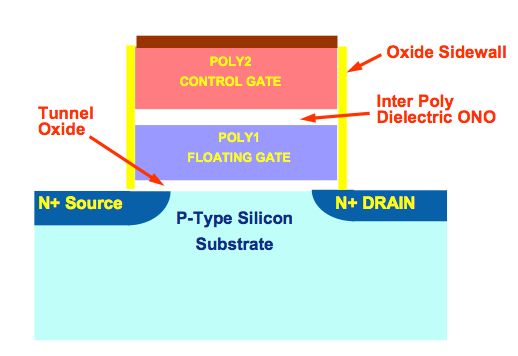
Between the floating gate and the substrate is the tunnel oxide – the barrier to the floating gate through which the electrons “tunnel” into the floating gate. The transistor either has electrons tunneled into the floating gate (indicating a logical 0) or does not have any electrons tunneled into the floating gate (indicating a logical 1). The process of forcing electrons into or out of the floating gate, called Fowler-Nordheim Tunneling (F-N Tunneling), is achieved by applying a voltage between the control gate and the source or drain. When the charge is removed, the floating gate either retains the electrons (if they were tunneled into the gate) or has no extra electrons if they were removed. This allows Flash memory to retain values after power is removed.
Read the rest at Enterprise Storage Forum.
RELATED NEWS AND ANALYSIS
-
Ethics and Artificial Intelligence: Driving Greater Equality
FEATURE | By James Maguire,
December 16, 2020 -
AI vs. Machine Learning vs. Deep Learning
FEATURE | By Cynthia Harvey,
December 11, 2020 -
Huawei’s AI Update: Things Are Moving Faster Than We Think
FEATURE | By Rob Enderle,
December 04, 2020 -
Keeping Machine Learning Algorithms Honest in the ‘Ethics-First’ Era
ARTIFICIAL INTELLIGENCE | By Guest Author,
November 18, 2020 -
Key Trends in Chatbots and RPA
FEATURE | By Guest Author,
November 10, 2020 -
FEATURE | By Samuel Greengard,
November 05, 2020 -
ARTIFICIAL INTELLIGENCE | By Guest Author,
November 02, 2020 -
How Intel’s Work With Autonomous Cars Could Redefine General Purpose AI
ARTIFICIAL INTELLIGENCE | By Rob Enderle,
October 29, 2020 -
Dell Technologies World: Weaving Together Human And Machine Interaction For AI And Robotics
ARTIFICIAL INTELLIGENCE | By Rob Enderle,
October 23, 2020 -
The Super Moderator, or How IBM Project Debater Could Save Social Media
FEATURE | By Rob Enderle,
October 16, 2020 -
FEATURE | By Cynthia Harvey,
October 07, 2020 -
ARTIFICIAL INTELLIGENCE | By Guest Author,
October 05, 2020 -
CIOs Discuss the Promise of AI and Data Science
FEATURE | By Guest Author,
September 25, 2020 -
Microsoft Is Building An AI Product That Could Predict The Future
FEATURE | By Rob Enderle,
September 25, 2020 -
Top 10 Machine Learning Companies 2021
FEATURE | By Cynthia Harvey,
September 22, 2020 -
NVIDIA and ARM: Massively Changing The AI Landscape
ARTIFICIAL INTELLIGENCE | By Rob Enderle,
September 18, 2020 -
Continuous Intelligence: Expert Discussion [Video and Podcast]
ARTIFICIAL INTELLIGENCE | By James Maguire,
September 14, 2020 -
Artificial Intelligence: Governance and Ethics [Video]
ARTIFICIAL INTELLIGENCE | By James Maguire,
September 13, 2020 -
IBM Watson At The US Open: Showcasing The Power Of A Mature Enterprise-Class AI
FEATURE | By Rob Enderle,
September 11, 2020 -
Artificial Intelligence: Perception vs. Reality
FEATURE | By James Maguire,
September 09, 2020
ARTICLES